"Is it a 5 MW plant or a 5 MWp plant?" is one of the most common — and most expensive — misunderstandings in solar. The two numbers describe different things: kWp and MWp are the DC nameplate of the modules; kW and MW (AC) are the inverter or grid-export capacity. Energy is a third quantity, measured in kWh, MWh or MU.
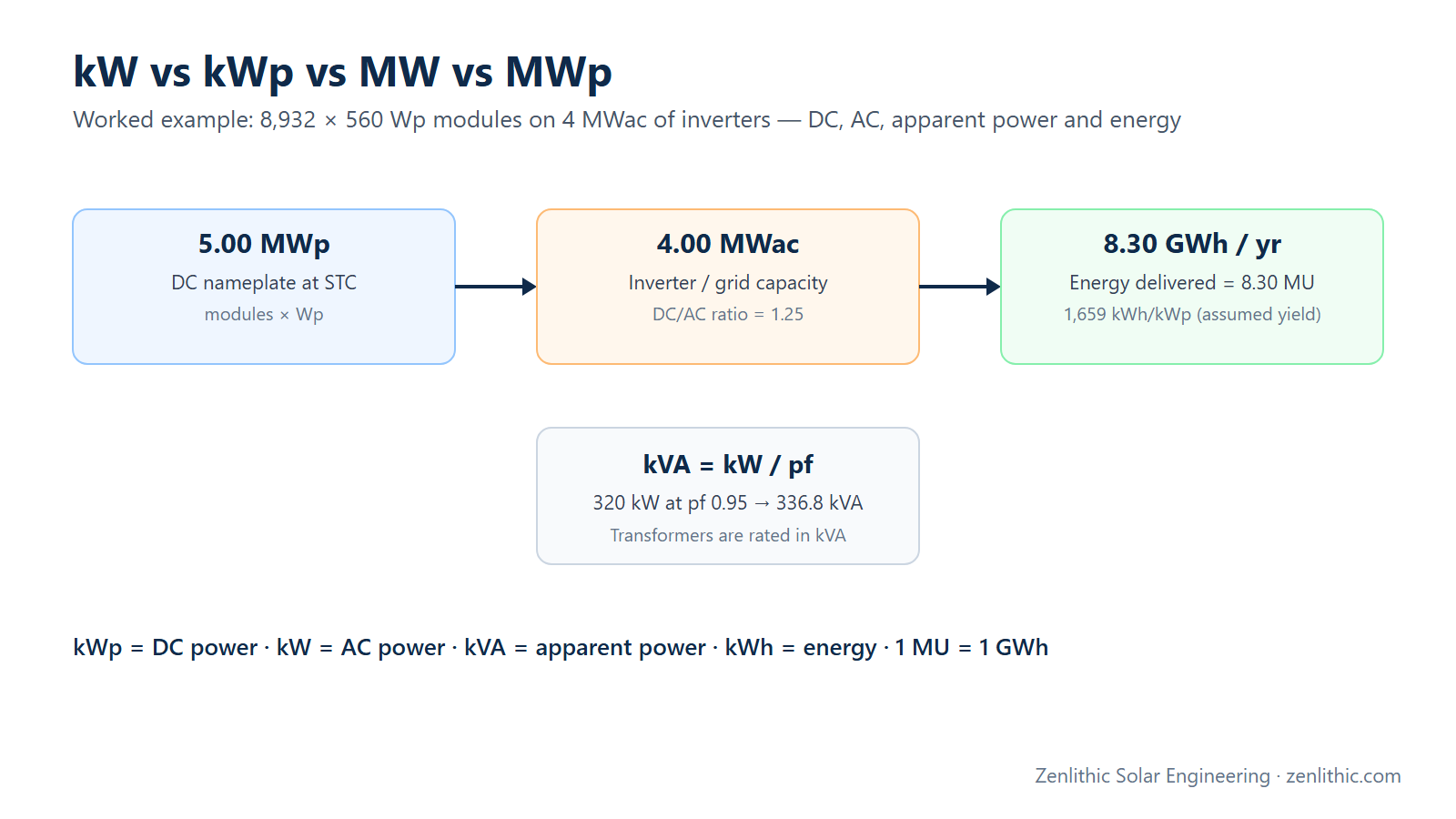
Quick answer: kWp (kilowatt-peak) is the modules' DC power at Standard Test Conditions; kW (AC) is what the inverters or the grid connection can deliver; kVA includes reactive power; kWh is energy over time. A plant with 5,000 kWp of modules and 4,000 kW of inverters is "5 MWp / 4 MWac" — a DC/AC ratio of 1.25 — and at an assumed specific yield of 1,659 kWh/kWp it produces about 8.30 GWh (8.30 MU) a year.
Introduction
Beginner understanding: A solar panel's label (for example 560 Wp) says how much power it produces in a standard laboratory test. Add up all the panel labels and you get the plant's kWp or MWp. The inverters then convert DC to AC and have their own rating in kW or MW. How much electricity the plant produces over a day or a year is energy, measured in kWh (a "unit" on your electricity bill).
Engineering understanding: Power ratings are instantaneous (W, kW, MW), energy is power integrated over time (Wh, kWh, MWh). The DC rating is referenced to STC (1000 W/m², 25 °C cell, AM1.5); the AC rating is the inverter's continuous active-power output, and the apparent-power rating (kVA) additionally bounds reactive-power capability. Contracts, tenders and grid-connection agreements normally specify AC capacity at a defined delivery point; module procurement and PVsyst use DC.
What is it?
| Unit | Quantity | Side | Where you see it |
|---|---|---|---|
| Wp, kWp, MWp | Peak DC power at STC | DC | Module datasheets, BOQ, PVsyst "Pnom" |
| W, kW, MW (AC) | Active power | AC | Inverter rating, grid/PPA capacity, sanctioned load |
| kVA, MVA | Apparent power | AC | Inverter and transformer ratings |
| kvar | Reactive power | AC | Grid-code requirements |
| kWh, MWh, GWh | Energy | AC (delivered) | Generation reports, bills, revenue |
| MU (million units) | Energy | AC | Indian regulatory and tender documents — 1 MU = 1 GWh = 1,000 MWh |
Why is it important?
- Tender compliance: Indian utility tenders usually define capacity in MW AC at the delivery point. Quoting MWp where MWac is required (or vice versa) changes the whole bid.
- Cost comparisons: "₹/Wp" and "₹/Wac" differ by the DC/AC ratio — a 1.3 ratio makes ₹/Wac 30 % higher for the same plant.
- Performance metrics: specific yield and PR are per kWp (DC); CUF in Indian contracts is normally per kW (AC). Mixing bases gives wrong conclusions.
- Rooftop approvals: net-metering limits are set by the applicable state regulation and DISCOM (often referenced to sanctioned load) — check whether the limit is on kWp or kW AC.
When is it used?
At every stage: proposals and tenders (capacity basis), design (DC/AC ratio), procurement (modules in Wp, inverters in kW/kVA), approvals (AC capacity at the connection point) and operation (energy in kWh/MU).
Where is it used?
| Document | Capacity basis normally used |
|---|---|
| Module BOQ, PVsyst array | kWp / MWp (DC) |
| Inverter schedule | kW and kVA (AC) |
| Grid connectivity / PPA / tender | MW (AC) at the delivery point — confirm in the document |
| Generation report / DPR | kWh, MWh or MU per year, plus kWh/kWp |
| Transformer | kVA / MVA |
How does it work?
DC capacity (kWp) = number of modules × module rating (Wp) / 1000
AC capacity (kW)  = number of inverters × inverter rating (kW)
DC/AC ratio       = kWp / kW(AC)
Apparent power    = kW / power factor  (kVA)
Energy (kWh)      = power (kW) × time (h), summed over the period
Required Input Data
- Module rating (Wp) and quantity.
- Inverter active-power rating (kW), apparent-power rating (kVA) and quantity.
- Contracted/export capacity and its definition (AC or DC, measurement point).
- Annual energy estimate (from PVsyst) for kWh/MU figures.
Step-by-Step Design Process
- Read the tender/PPA: is capacity defined in MW AC or MWp, and at which point?
- Calculate DC capacity from module count × Wp.
- Calculate AC capacity from inverter count × kW; check kVA if reactive power is required.
- State the DC/AC ratio.
- Express energy in kWh/MWh/MU with the capacity basis for specific yield (kWp) and CUF (kW AC) stated.
Formula
kWp = N_modules × Wp / 1000
R   = kWp / kW_AC
S (kVA) = P (kW) / pf
E (kWh) = Σ P(t) × Δt ;   1 MU = 10⁶ kWh
Specific yield (kWh/kWp) = E / kWp
CUF_AC = E / (kW_AC × 8,760)
Numerical Example
Target a 5 MWp plant with 560 Wp modules in 28-module strings (15.68 kWp per string, from our string sizing guide) and 4 MW of inverters. Assume the specific yield of our PR/CUF worked example: 1,659 kWh/kWp.
Engineering Calculation
Strings  = ceil(5,000 / 15.68) = ceil(318.9) = 319 strings
Modules  = 319 × 28 = 8,932 modules
DC       = 8,932 × 560 Wp = 5,001.9 kWp ≈ 5.00 MWp
AC       = 4,000 kW = 4.00 MWac
DC/AC    = 5,001.9 / 4,000 = 1.25

Energy (year 1, at 1,659 kWh/kWp) ≈ 5,000 × 1,659 = 8,295,000 kWh
                                  = 8,295 MWh = 8.30 GWh = 8.30 MU

Per kWp per day  = 1,659 / 365 ≈ 4.55 kWh/kWp/day
A 10 kWp rooftop at the same yield ≈ 45.5 kWh/day
Apparent power for one 320 kW inverter operating at pf 0.95:
S = 320 / 0.95 = 336.8 kVA
| Figure | Value | Unit | Basis |
|---|---|---|---|
| Module capacity | 5.00 | MWp | DC (STC) |
| Inverter capacity | 4.00 | MW | AC |
| DC/AC ratio | 1.25 | — | — |
| Annual energy | 8.30 | GWh = MU | AC, delivered |
| Specific yield | 1,659 | kWh/kWp | per DC kWp |
| CUF | 23.67 % / 18.94 % | — | AC / DC basis |
Practical Solar Application
- In a proposal, write "5.00 MWp DC / 4.00 MWac" — never just "5 MW".
- In a tender, match the capacity definition exactly; if the tender says MW AC at the delivery point, losses between inverter and meter matter.
- In PVsyst, the array Pnom is DC and the inverter Pnom is AC — the "Pnom ratio" shown is the DC/AC ratio (see DC/AC ratio and inverter sizing).
- For rooftop customers, "units per day" means kWh per day; a rule of thumb like "4 units per kWp per day" is site-specific (the example above gives 4.55 at an assumed high-irradiation site).
Design Considerations
- Confirm whether capacity limits (connectivity, net metering, subsidy caps) are in kWp or kW AC.
- Inverters may deliver rated kW only up to a certain ambient temperature — AC capacity can derate on hot afternoons.
- Transformer ratings are in kVA/MVA and must cover the inverters' apparent power, not just kW.
- Keep one capacity basis per metric in every report, and label it.
Common Mistakes
- Writing "MW" when the figure is MWp (or the reverse).
- Comparing ₹/Wp of one offer with ₹/Wac of another.
- Calculating CUF on DC capacity when the contract defines it on AC.
- Confusing kW (power) with kWh (energy) — a 10 kW system does not produce "10 kWh".
- Sizing transformers in kW instead of kVA.
Key Notes
- kWp = DC at STC; kW = AC active power; kVA = AC apparent power; kWh = energy.
- 1 MU = 1 GWh = 1,000 MWh = 1,000,000 kWh.
- Always write both: "X MWp DC / Y MWac".
- Specific yield per kWp; CUF per kW AC (state the basis).
Engineer's Checklist
- Capacity basis of the tender/PPA confirmed (AC/DC, delivery point)
- DC kWp = modules × Wp (matches BOQ and PVsyst)
- AC kW = inverters × kW (matches SLD)
- kVA checked where reactive power is required
- DC/AC ratio stated
- Energy in kWh/MWh/MU with basis for yield and CUF stated
FAQ
What is the difference between kW and kWp?
kWp is the modules' DC power at Standard Test Conditions; kW is AC power from the inverter or at the grid connection. A plant can be 5 MWp DC but only 4 MW AC.
Is a 1 MW solar plant 1 MWp or 1 MWac?
It depends on the document. Utility tenders in India usually mean MW AC at the delivery point, while module-based descriptions mean MWp. Always write both values.
How many units does 1 kWp of solar produce per day?
It depends on the site and design. At a specific yield of 1,659 kWh/kWp per year, 1 kWp produces about 4.55 units (kWh) per day on average; lower-irradiation sites produce less.
What is MU in solar?
MU means million units: one million kWh, which equals 1 GWh or 1,000 MWh. It is common in Indian regulatory and tender documents.
Why are transformers rated in kVA and not kW?
Transformers carry current regardless of power factor, so their heating depends on apparent power (kVA), which includes reactive power.
What does DC/AC ratio mean?
It is DC module capacity (kWp) divided by inverter AC capacity (kW). A 5 MWp array on 4 MW of inverters has a ratio of 1.25.
Conclusion
Use kWp for modules, kW for inverters and the grid, kVA for apparent power, and kWh/MU for energy — and label the basis every time. In the example, 8,932 modules make 5.00 MWp on 4.00 MWac of inverters (ratio 1.25), producing about 8.30 MU a year at the assumed yield.
Related reading: DC/AC ratio and inverter sizing · PR, CUF and generation calculation · Solar transformer sizing
Need professional solar PV design, PVsyst simulation, AutoCAD drawings or electrical design support? Zenlithic provides solar design consultancy and engineering support for rooftop, C&I and utility-scale projects — capacity planning, DPR/DBR preparation and tender technical documentation. Explore Zenlithic Solar or contact our engineering team.