Every feasibility report, DPR, PPA negotiation and O&M review eventually asks the same questions: how much energy will this plant produce, and is it performing as it should? Three numbers answer them — specific yield, performance ratio (PR) and capacity utilisation factor (CUF). They are simple to calculate but easy to misuse, especially CUF, which can be quoted on AC or DC capacity.
This guide defines each metric, shows how they relate, and works through a complete 5 MWp example with every assumption stated.
Quick answer: annual energy = DC capacity (kWp) × plane-of-array irradiation (kWh/m²) × PR. For 5 MWp at 2,100 kWh/m² and PR 0.79 that is 8.30 GWh (8.30 MU) — a specific yield of 1,659 kWh/kWp and a CUF of 23.67 % on 4 MWac (18.94 % on DC capacity). Always state whether CUF is on AC or DC.
Introduction
Beginner understanding: A solar plant's output depends on how much sunlight falls on the panels and how efficiently the plant turns that sunlight into electricity delivered to the grid. Specific yield is the energy produced per kWp of panels. PR tells you what fraction of the theoretically available energy the plant actually delivered, after heat, dust, cable, inverter and other losses. CUF compares the actual energy with what the plant would produce if it ran at full capacity 24 hours a day all year.
Engineering understanding: Using the IEC 61724-1 framework, the reference yield Y_r is the in-plane irradiation divided by the reference irradiance (1 kW/m²), expressed in hours; the final yield Y_f is the net AC energy divided by the DC STC rating; and PR = Y_f / Y_r. PR normalises for irradiation, so it measures system losses. CUF is an Indian-market (and PPA) metric that normalises energy by rated capacity × 8,760 h and must always state the capacity basis.
What is it?
| Metric | Definition | Unit | Normalises for |
|---|---|---|---|
| Reference yield Y_r | H_POA / G_STC | h (kWh/kWp) | Solar resource |
| Specific (final) yield Y_f | E_AC / P_DC,STC | kWh/kWp | Plant size |
| Performance ratio PR | Y_f / Y_r | % or p.u. | Size and irradiation |
| CUF (AC) | E_AC / (P_AC × 8,760) | % | Inverter/contracted capacity |
| CUF (DC) | E_AC / (P_DC × 8,760) | % | Module capacity |
Why is it important?
- Bankability: lenders and investors size debt on expected annual energy (often at P50/P90 exceedance levels).
- Contracts: PPAs and tenders commonly specify minimum CUF or generation guarantees.
- Performance testing: PR (often temperature-corrected, as described in IEC 61724-1) is used in EPC performance guarantees and acceptance tests.
- O&M: a falling PR flags soiling, failures or degradation before revenue losses accumulate.
When is it used?
- Pre-feasibility and DPR: estimating generation and revenue.
- Design: comparing module, tilt and DC/AC options in PVsyst.
- Commissioning: performance ratio tests.
- Operation: monthly and annual performance reporting.
Where is it used?
Rooftop, C&I and utility-scale plants. CUF is widely used in India (tenders, PPAs, regulatory filings); specific yield and PR are used internationally.
How does it work?
Energy delivered is the available irradiation, scaled by plant size, reduced by the product of all loss factors:
E_AC = P_DC,STC × (H_POA / G_STC) × PR
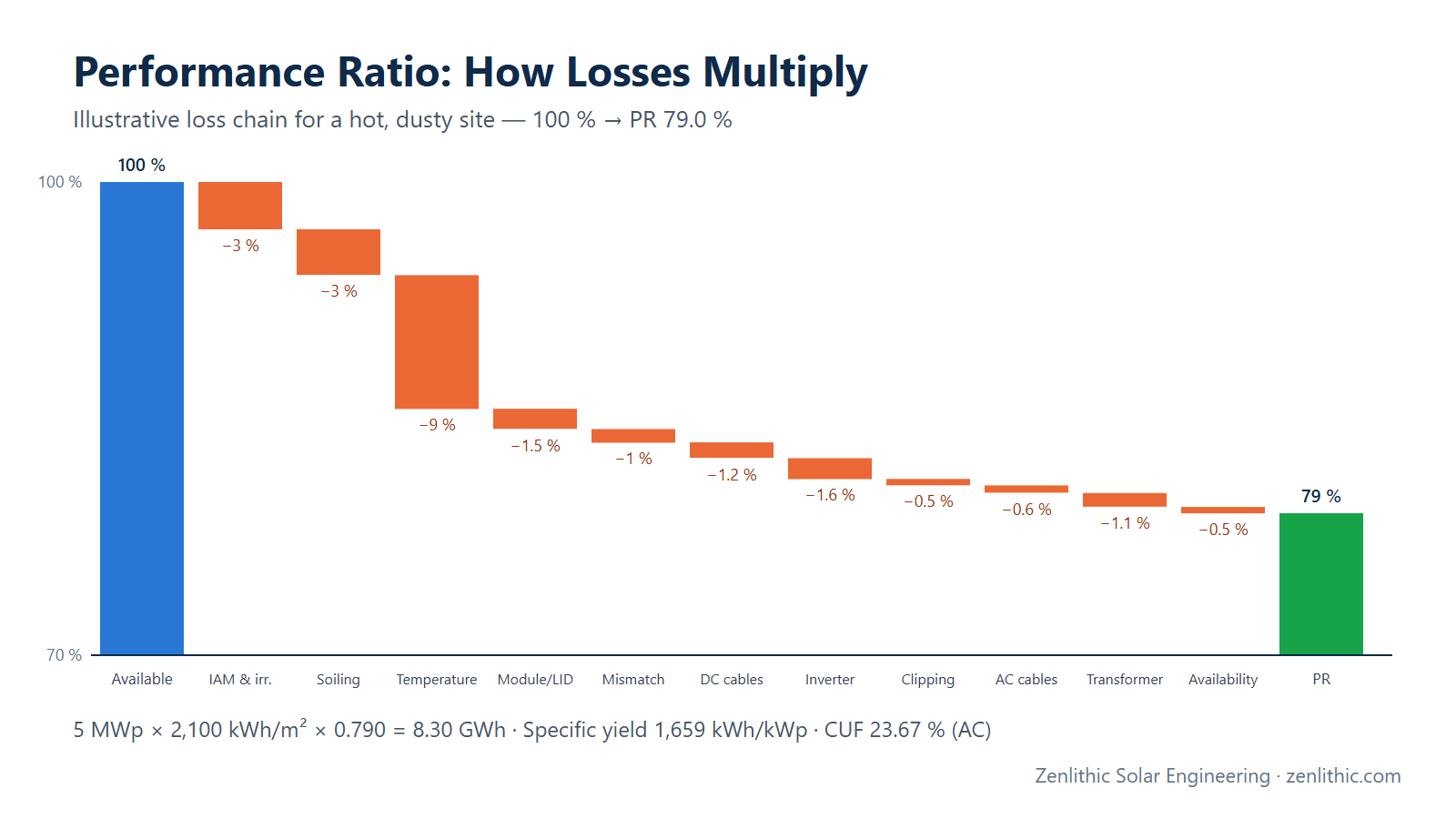
PR is the product of the individual efficiency factors (1 − loss) across the energy chain: optical, soiling, irradiance level, temperature, module quality, mismatch, DC wiring, inverter, clipping, AC wiring, transformer and availability.
Required Input Data
| Input | Source | Example value (assumption) |
|---|---|---|
| DC capacity at STC | Design | 5,000 kWp |
| AC capacity (inverter / contracted) | Design / PPA | 4,000 kW (DC/AC = 1.25) |
| Annual in-plane irradiation H_POA | Meteonorm / Solargis / NASA → PVsyst transposition | 2,100 kWh/m²·yr (assumed site in western India) |
| Loss factors | PVsyst / design / O&M history | See loss chain below |
| Tariff | PPA | ₹2.60/kWh (assumed) |
| Annual degradation | Module warranty / datasheet | 0.4 %/yr (assumed) |
Always take irradiation from a recognised meteorological dataset for the actual site and transposition to your tilt. The 2,100 kWh/m² used here is an assumption for illustration.
Step-by-Step Design Process
- Obtain site GHI and transpose to the plane of array (H_POA) for the design tilt and azimuth.
- Calculate the reference yield Y_r = H_POA / 1 kW/m².
- Build the loss chain and calculate PR as the product of efficiency factors (or take PR from PVsyst).
- Calculate annual energy E_AC = P_DC × Y_r × PR.
- Derive specific yield, daily/monthly averages and CUF on both AC and DC bases.
- Apply degradation for future years.
- Calculate revenue from the tariff.
- Document every assumption in the DPR/generation report.
Formula
Y_r  = H_POA / G_STC                         (G_STC = 1 kW/m²)
E_AC = P_DC,STC × Y_r × PR
Y_f  = E_AC / P_DC,STC
PR   = Y_f / Y_r
CUF_AC = E_AC / (P_AC × 8,760 h)
CUF_DC = E_AC / (P_DC × 8,760 h)
CUF_AC = CUF_DC × (P_DC / P_AC)
E_year n = E_year1 × (1 − d)^(n − 1)
Numerical Example
Plant: 5 MWp DC, 4 MW AC, fixed tilt, H_POA = 2,100 kWh/m²·yr (assumed), tariff ₹2.60/kWh (assumed), degradation 0.4 %/yr (assumed).
Engineering Calculation
Step 1 — Loss chain and PR (illustrative loss values for a hot, dusty site; replace with your PVsyst results)
| Loss | Loss % | Factor | Cumulative PR |
|---|---|---|---|
| Incidence angle (IAM) & irradiance level | 3.0 | 0.970 | 0.9700 |
| Soiling | 3.0 | 0.970 | 0.9409 |
| Temperature | 9.0 | 0.910 | 0.8562 |
| Module quality / LID | 1.5 | 0.985 | 0.8434 |
| Mismatch | 1.0 | 0.990 | 0.8349 |
| DC ohmic (cables) | 1.2 | 0.988 | 0.8249 |
| Inverter efficiency | 1.6 | 0.984 | 0.8117 |
| Inverter clipping | 0.5 | 0.995 | 0.8077 |
| AC ohmic (LV cables) | 0.6 | 0.994 | 0.8028 |
| Transformer | 1.1 | 0.989 | 0.7940 |
| Availability / grid | 0.5 | 0.995 | 0.7900 |
Losses combine by multiplication, not addition: the listed losses add up to 23.0 %, but the resulting PR is 79.0 % (a combined loss of 21.0 %), because each loss applies to what remains after the previous ones.
Step 2 — Reference yield
Y_r = 2,100 kWh/m² / 1 kW/m² = 2,100 h
Step 3 — Annual energy
E_AC = 5,000 kWp × 2,100 h × 0.790 = 8,295,000 kWh ≈ 8.30 GWh (year 1)
Step 4 — Specific yield, daily and monthly averages
Y_f = 8,295,000 / 5,000 = 1,659 kWh/kWp
Average daily   = 8,295,000 / 365 = 22,726 kWh/day
Average monthly = 8,295,000 / 12  = 691,250 kWh/month
Monthly generation is not uniform. It follows monthly H_POA and monthly PR (PR is usually higher in cooler months). For example, if March has H_POA = 205 kWh/m² and PR = 0.80 (assumed):
E_March = 5,000 × 205 × 0.80 = 820,000 kWh
Step 5 — CUF
CUF_AC = 8,295,000 / (4,000 × 8,760) = 8,295,000 / 35,040,000 = 23.67 %
CUF_DC = 8,295,000 / (5,000 × 8,760) = 8,295,000 / 43,800,000 = 18.94 %
Check: 18.94 % × (5,000 / 4,000) = 23.67 % ✅
Step 6 — Revenue (year 1)
Revenue = 8,295,000 kWh × ₹2.60 = ₹2,15,67,000 ≈ ₹2.16 crore
Step 7 — Degradation (year 2)
E_year2 = 8,295,000 × (1 − 0.004) = 8,261,820 kWh
| Result | Value |
|---|---|
| Annual energy (year 1) | 8.295 GWh |
| Specific yield | 1,659 kWh/kWp |
| PR | 79.0 % |
| CUF on AC (4 MW) | 23.67 % |
| CUF on DC (5 MWp) | 18.94 % |
| Average daily energy | 22,726 kWh |
| Year-1 revenue at ₹2.60/kWh | ≈ ₹2.16 crore |
Practical Solar Application
- In a DPR, report energy with the dataset, transposition model, loss assumptions and exceedance level (P50/P90) stated.
- In tenders, check whether the required CUF is on AC or DC capacity before comparing offers.
- In O&M, track monthly PR against the PVsyst monthly PR; a persistent gap usually points to soiling, string failures, inverter downtime or shading.
- The DC/AC ratio affects CUF_AC strongly but PR only through clipping — see DC/AC ratio and inverter sizing.
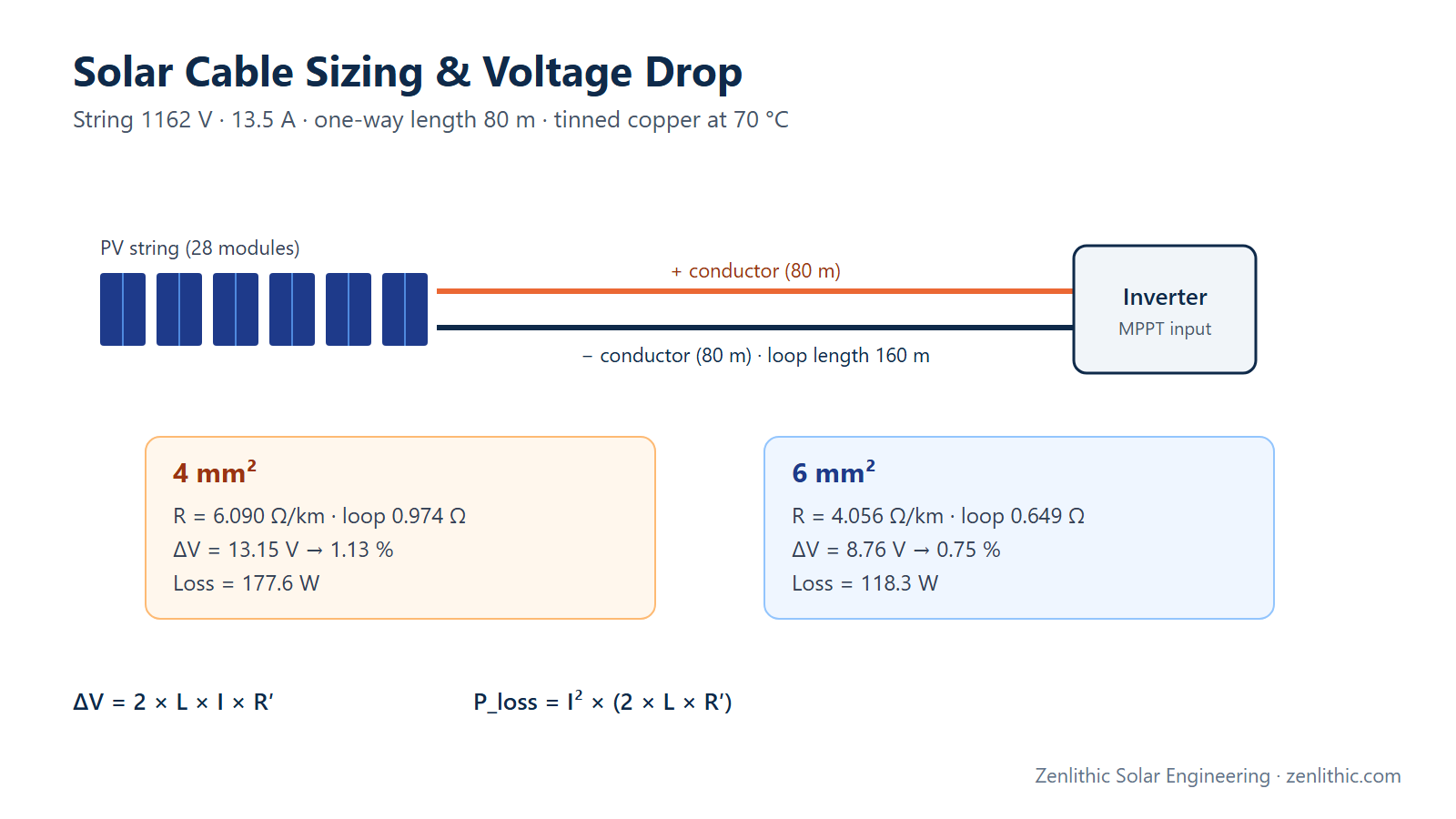
- Cable losses in the loss chain come from the cable sizing and voltage drop design.
Design Considerations
- Irradiation data quality is usually the largest single uncertainty in a generation estimate.
- Temperature loss dominates in hot climates; module temperature coefficient and mounting (ventilation) matter.
- Soiling depends on site dust and cleaning frequency — it is an O&M assumption, not a constant.
- PR is not an efficiency: a PR of 79 % does not mean the modules are 79 % efficient.
- Degradation assumptions should follow the module warranty and be applied consistently across the financial model.
- Grid availability and curtailment can be significant in some regions and should be stated separately.
Common Mistakes
- Quoting CUF without stating AC or DC basis.
- Adding losses instead of multiplying the factors.
- Using GHI instead of POA irradiation in the PR formula.
- Calculating PR with AC capacity instead of DC STC capacity.
- Assuming equal monthly generation.
- Presenting an assumed irradiation or loss value as a measured or guaranteed figure.
Key Notes
- E = P_DC × (H_POA / 1 kW/m²) × PR.
- PR = Y_f / Y_r (IEC 61724-1 framework); CUF = E / (P × 8,760).
- CUF_AC = CUF_DC × DC/AC ratio.
- Losses multiply.
- State every assumption and data source.
Engineer's Checklist
- Irradiation source, period and transposition model documented
- H_POA (not GHI) used for reference yield
- Loss chain complete and multiplied
- PR referenced to DC STC capacity
- CUF stated on AC and DC basis
- Monthly profile from simulation, not equal split
- Degradation, availability and curtailment assumptions stated
- Revenue uses the contracted tariff and delivery point
- Results cross-checked (CUF_AC = CUF_DC × ratio)
FAQ
What is a good performance ratio for a solar plant?
It depends on climate and design. Hot climates have higher temperature losses and therefore lower PR than cool climates. Compare PR against the simulated PR for the same site and period, rather than against a universal number.
What is the difference between PR and CUF?
PR normalises energy by irradiation and DC capacity, so it measures how well the plant converts the available sunlight. CUF normalises energy by capacity × 8,760 hours, so it also depends on how sunny the site is and on the DC/AC ratio.
How do I calculate solar generation per day?
Daily energy ≈ P_DC × daily H_POA (kWh/m²) × PR. For a 5 MWp plant with 5.75 kWh/m²/day POA and PR 0.79, that is about 22.7 MWh per day.
Is CUF calculated on AC or DC capacity?
Either is used, so it must always be stated. Indian tenders and PPAs commonly define CUF on the contracted AC capacity — check the definition in your contract.
Why is PR lower in summer?
Higher cell temperatures reduce module output, so temperature loss increases and PR falls even though total energy may be higher.
What is temperature-corrected PR?
A version of PR that adjusts for the difference between actual and reference cell temperature, so performance tests are not distorted by weather. IEC 61724-1 describes temperature-corrected performance metrics.
Conclusion
With a stated irradiation, an explicit loss chain and the right capacity basis, generation metrics are straightforward: the 5 MWp example gives 8.30 GWh, 1,659 kWh/kWp, PR 79.0 % and a CUF of 23.67 % on AC (18.94 % on DC). The most valuable habit is documenting assumptions — it makes estimates comparable and defensible in DPRs, bids and performance reviews.
Related reading: Solar string sizing calculation · DC/AC ratio and inverter sizing · Row spacing, pitch and GCR
Need professional solar PV design, PVsyst simulation, AutoCAD drawings or electrical design support? Zenlithic provides solar design consultancy and engineering support for rooftop, C&I and utility-scale projects — PVsyst generation reports, DPR/DBR preparation and technical due diligence. Explore Zenlithic Solar or contact our engineering team.