Every energy estimate starts from the solar resource — and the resource is described by several different quantities. Weather files give GHI, DNI and DHI; modules respond to POA (plane-of-array) irradiance. Using the wrong one is one of the most common reasons PR and generation figures do not add up.
Quick answer: GHI is total sunlight on a horizontal surface; DNI is direct-beam sunlight on a surface facing the sun; DHI is diffuse sky light on a horizontal surface; POA is the total arriving on the tilted module plane. They are linked by GHI = DNI × cos(θz) + DHI. For generation and PR, use POA (PVsyst's "GlobInc"), not GHI — in the worked example, a GHI of 836 W/m² becomes 950 W/m² on a 25° south-facing plane.
Introduction
Beginner understanding: Sunlight reaches the ground in two ways — straight from the sun (direct) and scattered by the sky and clouds (diffuse). Weather stations measure these on a flat, horizontal surface. Solar panels are tilted towards the sun, so they usually catch more light than a flat surface. Engineers convert the flat-surface measurements into the light that actually reaches the tilted panels.
Engineering understanding: GHI, DNI and DHI are the three components of the horizontal solar resource and are related by the closure equation. Transposition models (isotropic, Hay-Davies, Perez) convert them into plane-of-array irradiance by adding the beam component projected onto the tilted surface, a sky-diffuse component weighted by the surface's view of the sky, and a ground-reflected component depending on albedo. PVsyst reports the annual POA irradiation as GlobInc; PR is defined against it.
What is it?
| Quantity | Symbol | Definition | Typical unit |
|---|---|---|---|
| Global horizontal irradiance | GHI | Total (direct + diffuse) on a horizontal plane | W/m² |
| Direct normal irradiance | DNI | Direct beam on a plane perpendicular to the sun's rays | W/m² |
| Diffuse horizontal irradiance | DHI | Scattered sky radiation on a horizontal plane | W/m² |
| Plane-of-array irradiance | POA / G_POA | Total on the tilted module plane | W/m² |
| Irradiation | H | Irradiance integrated over time | kWh/m² per day/month/year |
Irradiance (W/m²) is instantaneous power; irradiation (kWh/m²) is energy over a period. "Peak sun hours" is the daily irradiation expressed in kWh/m² — numerically equal to hours at 1000 W/m².
Why is it important?
- Generation estimates use POA irradiation multiplied by capacity and PR (see PR, CUF and generation calculation).
- PR computed with GHI instead of POA is wrong — for tilted fixed arrays it typically overstates PR.
- Comparing sites or datasets on GHI alone hides differences in the direct/diffuse split, which matter for tilt and trackers.
- Resource data quality is usually the largest single uncertainty in a bankable energy estimate.
When is it used?
- Pre-feasibility: annual GHI from a dataset to screen sites.
- Design: POA transposition to choose tilt and azimuth.
- Simulation: PVsyst uses hourly GHI/DHI (or DNI) with a transposition model.
- Operation: on-site pyranometers measure POA (and often GHI) for PR monitoring.
Where is it used?
Every PV project: rooftop (tilted or flush-mounted), fixed-tilt ground-mounted and tracking plants (where POA changes through the day as the modules move).
How does it work?
Closure equation (relates the three horizontal components):
GHI = DNI × cos(θz) + DHI θz = solar zenith angle = 90° − solar altitude
Isotropic sky transposition (Liu–Jordan; simplest model):
G_POA = DNI × cos(AOI)                    ← beam on the tilted plane
      + DHI × (1 + cos β) / 2             ← sky diffuse (isotropic)
      + GHI × ρ × (1 − cos β) / 2         ← ground-reflected (albedo ρ)
where β is the tilt and AOI the angle of incidence of the beam on the module plane. More advanced models (Hay–Davies, Perez) treat circumsolar and horizon-brightening diffuse light separately and are the usual choices in PVsyst; the isotropic model is shown here because it can be checked by hand.
Required Input Data
| Input | Source |
|---|---|
| GHI, DHI (and/or DNI) — hourly or monthly | Meteorological dataset (e.g. Meteonorm, Solargis, NASA POWER, PVGIS, NSRDB) or on-site measurement |
| Sun position (zenith, azimuth) | Calculated from latitude, date and time |
| Tilt β and azimuth of the array | Design |
| Ground albedo ρ | Site surface (commonly ≈ 0.2 for grass/soil; higher for light surfaces) |
Step-by-Step Design Process
- Select a resource dataset and record its source and period.
- Check GHI/DHI plausibility (monthly totals, diffuse fraction).
- Choose tilt and azimuth; compute sun position for each hour.
- Transpose to POA with the chosen model (PVsyst does this hourly).
- Sum hourly POA to monthly/annual irradiation (GlobInc).
- Use GlobInc for reference yield and PR.
Formula
θz = 90° − α
GHI = DNI cos θz + DHI
G_POA = DNI cos(AOI) + DHI (1 + cos β)/2 + GHI ρ (1 − cos β)/2
For a south-facing plane at solar noon (sun due south): AOI = θz − β
Y_r = H_POA / 1 kW/m²   (hours)
Numerical Example
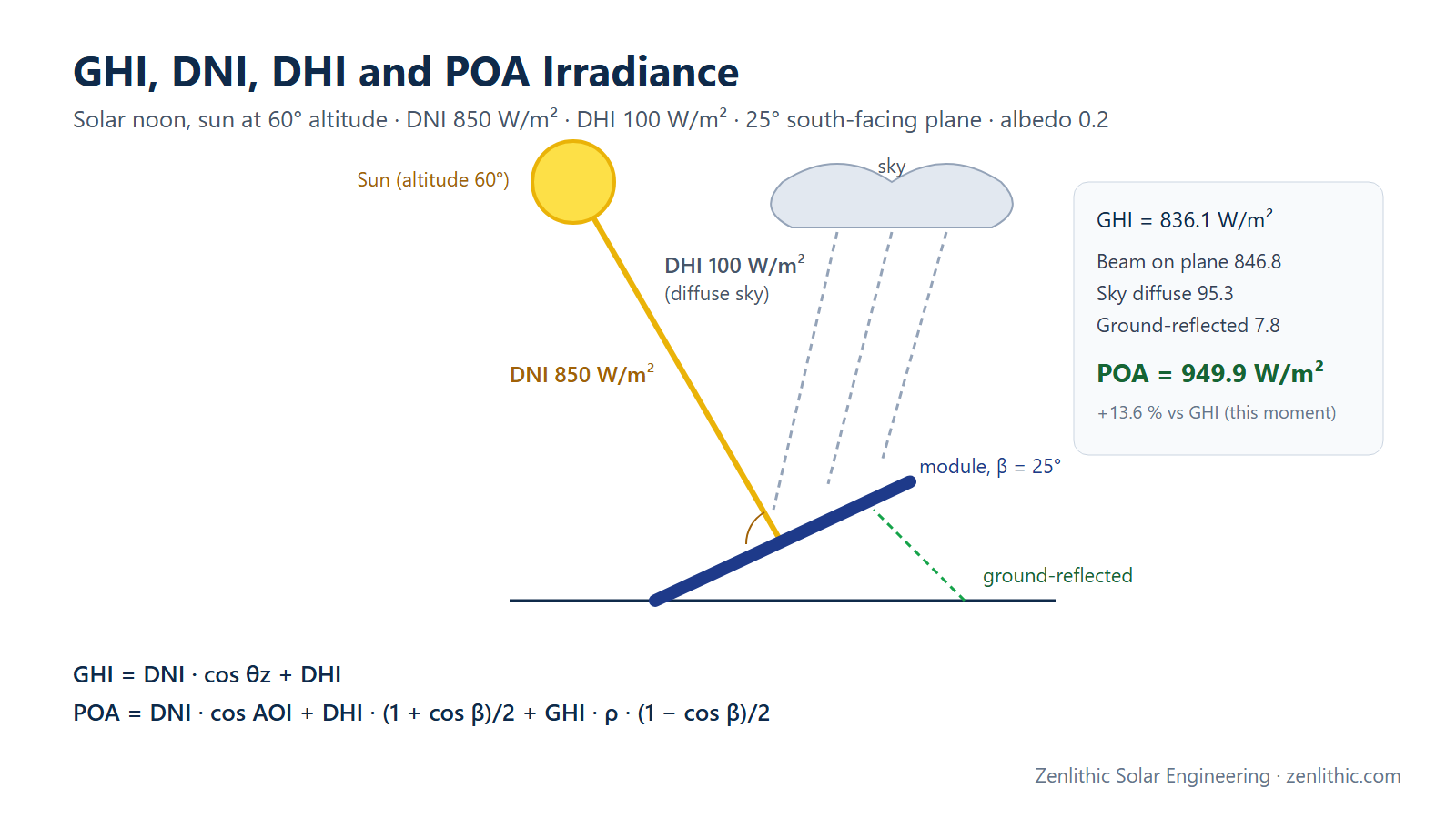
Solar noon, sun due south at 60° altitude (θz = 30°). Measured DNI = 850 W/m², DHI = 100 W/m². Array tilted β = 25° facing south, albedo ρ = 0.2.
Engineering Calculation
Step 1 — GHI from the closure equation
GHI = 850 × cos 30° + 100 = 850 × 0.8660 + 100 = 736.1 + 100 = 836.1 W/m²
Step 2 — Angle of incidence (south-facing plane, sun due south)
AOI = θz − β = 30° − 25° = 5°
Step 3 — Components on the tilted plane
Beam      = 850 × cos 5°                    = 850 × 0.9962        = 846.8 W/m²
Sky diff. = 100 × (1 + cos 25°) / 2         = 100 × 0.9532        =  95.3 W/m²
Reflected = 836.1 × 0.2 × (1 − cos 25°) / 2 = 836.1 × 0.2 × 0.0468 =   7.8 W/m²
G_POA     = 846.8 + 95.3 + 7.8 = 949.9 W/m²
Result: the tilted plane receives 949.9 W/m², about 13.6 % more than the horizontal GHI of 836.1 W/m² at this moment. Over a whole year the gain from tilting is smaller than this noon value and depends on latitude and climate — that is why tilt is optimised with annual hourly simulation.
Irradiation ↔ peak sun hours: an annual POA irradiation of 2,100 kWh/m² is an average of 2,100 / 365 = 5.75 kWh/m²/day, i.e. 5.75 peak sun hours per day.
Practical Solar Application
- Enter the dataset in PVsyst; check the transposition model in the project settings and the resulting GlobInc in the report.
- Compute PR against GlobInc, never against GlobHor.
- For monitoring, install a POA pyranometer (or reference cell) in the array plane; PR tests rely on it.
- Tilt choices from this transposition feed the row spacing and GCR calculation.
Design Considerations
- Datasets differ — for bankable studies, compare at least two sources and document the one chosen.
- High-diffuse climates gain less from tilt and trackers than clear-sky climates.
- Albedo matters more for bifacial modules (rear-side irradiance) and high tilts.
- Soiling and shading are not in POA irradiance — they are separate losses in the loss chain.
Common Mistakes
- Using GHI instead of POA for PR or reference yield.
- Mixing irradiance (W/m²) and irradiation (kWh/m²).
- Using a monthly dataset for a clipping or high-DC/AC study (needs hourly data).
- Forgetting the dataset period and source in reports.
- Treating the noon tilt gain as the annual gain.
Key Notes
- GHI = DNI cos θz + DHI.
- Modules respond to POA; PVsyst calls annual POA irradiation GlobInc.
- Irradiance is W/m²; irradiation is kWh/m²; peak sun hours = daily kWh/m².
- Isotropic transposition is hand-checkable; Perez/Hay–Davies are more accurate.
Engineer's Checklist
- Resource dataset, version and period documented
- Monthly GHI and diffuse fraction checked for plausibility
- Transposition model recorded (PVsyst setting)
- Albedo justified (especially for bifacial)
- PR and reference yield based on POA (GlobInc)
- On-site POA sensor planned for performance monitoring
FAQ
What is the difference between GHI and POA?
GHI is total irradiance on a horizontal surface; POA is total irradiance on the tilted module plane. POA is what the modules actually receive and is usually higher than GHI for a well-oriented fixed tilt.
What is DNI used for?
DNI measures the direct beam from the sun. It is used to calculate the beam component on any tilted plane, and it matters most for trackers and concentrating systems.
Should PR be calculated with GHI or POA?
With POA irradiation (PVsyst's GlobInc). Using GHI gives a misleading PR for tilted arrays.
What are peak sun hours?
Daily irradiation expressed in kWh/m², which equals the number of hours at 1000 W/m² that would deliver the same energy — for example 5.75 kWh/m²/day equals 5.75 peak sun hours.
Which transposition model does PVsyst use?
PVsyst offers several models, including Hay–Davies and Perez; check the setting in the project, because it changes the POA result.
Why do solar resource datasets give different values?
They use different satellite and ground data, periods and processing methods. Bankable studies compare sources and document the one chosen.
Conclusion
GHI, DNI and DHI describe the horizontal resource; POA is what reaches the modules and is the basis for yield and PR. In the worked example, the closure equation gives a GHI of 836.1 W/m², and isotropic transposition raises it to 949.9 W/m² on a 25° south-facing plane.
Related reading: PR, CUF and generation calculation · Row spacing, pitch and GCR · kW vs kWp vs MW vs MWp
Need professional solar PV design, PVsyst simulation, AutoCAD drawings or electrical design support? Zenlithic provides solar design consultancy and engineering support for rooftop, C&I and utility-scale projects — resource assessment, PVsyst energy yield studies and DPRs. Explore Zenlithic Solar or contact our engineering team.