String sizing has two halves. The voltage half — how many modules in series — is covered in our string sizing guide. This article covers the current half: how many of those strings can be connected in parallel on one MPPT input, and when that parallel connection needs string fuses.
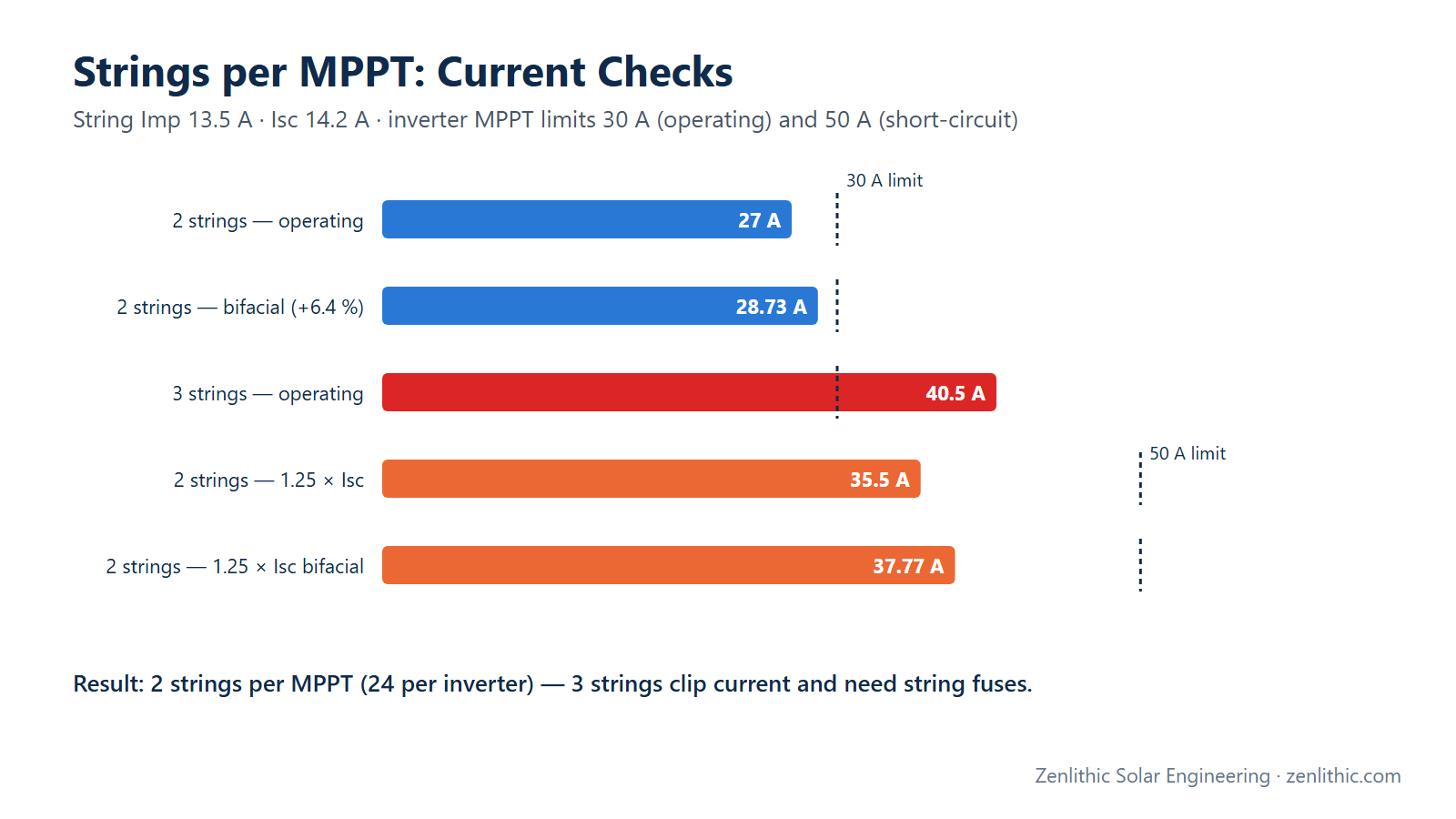
Quick answer: strings per MPPT = floor(inverter maximum input current per MPPT ÷ string Imp), then check that strings × 1.25 × Isc stays within the inverter's maximum short-circuit current per MPPT. For a 13.5 A / 14.2 A string on a 30 A / 50 A MPPT, that gives 2 strings (27.0 A operating, 35.5 A short-circuit). With bifacial gain the operating current rises to about 28.7 A — still within 30 A, but with little margin.
Introduction
Beginner understanding: In parallel, strings add their currents together. Each inverter input (MPPT) can accept only a certain current. So after deciding how many modules go in each string, engineers check how many strings one input can safely take.
Engineering understanding: Parallel strings on an MPPT are limited by (1) the inverter's maximum usable input current per MPPT — above it the inverter limits current and energy is lost, (2) the maximum short-circuit current per MPPT — a hard hardware limit using the conservative 1.25 × Isc design current, and (3) reverse-current protection — when enough strings are paralleled, a fault in one string can be fed by the others and overcurrent protection (string fuses) becomes necessary, per IEC 62548.
What is it?
| Check | Limit (from datasheet) | Nature |
|---|---|---|
| Operating current per MPPT | Max input current (e.g. 30 A) | Energy limit — excess current is not converted |
| Short-circuit current per MPPT | Max short-circuit current (e.g. 50 A) | Hard safety limit |
| Reverse current into a faulted string | Module maximum series fuse rating (e.g. 30 A) | Decides whether string fuses are needed |
| Strings per inverter | Number of MPPTs × inputs per MPPT | Hardware limit |
Why is it important?
- Exceeding the short-circuit limit risks inverter damage and voids warranties.
- Exceeding the operating limit causes current clipping — lost energy at every high-irradiance hour.
- Missing string fuses where they are required is a safety non-conformity.
- The number of strings per inverter determines the DC/AC ratio (see DC/AC ratio and inverter sizing).
When is it used?
During inverter selection and string layout, whenever the module, the inverter or the bifacial assumptions change, and in PVsyst's array definition (which warns on current overload).
Where is it used?
String inverters (multiple MPPTs with one to three inputs each), and central inverters with DC combiner boxes (where the same logic applies to strings per combiner).
How does it work?
Operating current   = Np × Imp            ≤ I_MPPT,max
Short-circuit check = Np × 1.25 × Isc     ≤ I_SC,MPPT,max
Bifacial current    ≈ Imp × (1 + φ × r)   φ = bifaciality factor, r = rear/front irradiance ratio
Reverse-current     = (Np − 1) × I_SC,MAX  compared with the module's maximum series fuse rating
Required Input Data
| Input | Example (assumed where marked) |
|---|---|
| String Imp / Isc (STC) | 13.5 A / 14.2 A |
| Inverter max input current per MPPT | 30 A |
| Inverter max short-circuit current per MPPT | 50 A |
| MPPTs × inputs per MPPT | 12 × 2 |
| Bifaciality factor φ | 0.80 (assumed; from module datasheet) |
| Rear/front irradiance ratio r | 0.08 (assumed; depends on albedo, height and pitch — take from PVsyst) |
| Module maximum series fuse rating | 30 A (assumed; from module datasheet) |
Step-by-Step Design Process
- Take string Imp and Isc from the module datasheet (bifacial: use the datasheet's bifacial values or apply the expected gain).
- Np,max,op = floor(I_MPPT,max / Imp).
- Check Np × 1.25 × Isc ≤ I_SC,MPPT,max; reduce Np if not.
- Check the reverse-current condition to decide on string fuses.
- Check that strings on the same MPPT have equal length and orientation.
- Multiply by MPPT count for strings per inverter; derive the DC/AC ratio.
- Confirm in PVsyst (no current-overload warning).
Formula
Np ≤ floor(I_MPPT,max / Imp)
Np × 1.25 × Isc ≤ I_SC,MPPT,max
I_bifacial ≈ I × (1 + φ × r)
Fuse needed if (Np − 1) × I_SC,MAX > module maximum series fuse rating   (see IEC 62548 for the exact condition)
Numerical Example
28-module strings of a 560 Wp module (Imp 13.5 A, Isc 14.2 A) on a 12-MPPT inverter (30 A / 50 A per MPPT, 2 inputs per MPPT). Check 2 and 3 strings per MPPT, monofacial and bifacial.
Engineering Calculation
Step 1 — Operating current (monofacial)
Np,max = floor(30 / 13.5) = floor(2.22) = 2
2 strings: 2 × 13.5 = 27.0 A ≤ 30 A  ✅
3 strings: 3 × 13.5 = 40.5 A > 30 A  ❌ (current clipping)
Step 2 — Short-circuit current
2 strings: 2 × 1.25 × 14.2 = 35.5 A ≤ 50 A ✅
Step 3 — Bifacial gain (φ = 0.80, r = 0.08)
Gain factor = 1 + 0.80 × 0.08 = 1.064
2 strings operating:     2 × 13.5 × 1.064 = 28.73 A ≤ 30 A  ✅ (4.2 % margin)
2 strings short-circuit: 2 × 1.25 × 14.2 × 1.064 = 37.77 A ≤ 50 A  ✅
Step 4 — String fuses (reverse current) with I_SC,MAX = 1.25 × 14.2 = 17.75 A and a 30 A module fuse rating:
| Strings in parallel (Np) | Reverse current (Np − 1) × 17.75 A | vs 30 A | String fuses |
|---|---|---|---|
| 2 | 17.75 A | ✅ below | Not required by this check |
| 3 | 35.50 A | ❌ above | Required — evaluate per IEC 62548 |
| 4 | 53.25 A | ❌ above | Required |
Result: 2 strings per MPPT, 24 strings per inverter, no string fuses needed on the MPPT inputs. With bifacial modules the design still passes, but a higher rear-side gain (higher albedo or mounting height) could push operating current past 30 A — check the PVsyst bifacial result before adding DC capacity.
Practical Solar Application
- The result sets strings per inverter = 24, which with 15.68 kWp strings gives 376.3 kWp per inverter (DC/AC 1.18 on a 320 kW inverter).
- On a rooftop with two orientations (e.g. east and west), put each orientation on its own MPPT — never mix orientations on one MPPT.
- For central inverters, the same current checks apply to strings per combiner box, and combiner boxes include string fuses when paralleling many strings.
- String cable sizing uses the same 1.25 × Isc design current (see cable sizing and voltage drop).
Design Considerations
- Use the bifacial Isc/Imp from the datasheet (at the stated bifacial gain) or from PVsyst — not the front-face values alone.
- Some inverters allow a small current overload with automatic limiting; read the datasheet wording on "max usable" vs "max short-circuit" current.
- Module reverse-current / series fuse rating is on the datasheet and must be respected.
- Degradation slightly reduces current over time; the design is checked at beginning of life.
- In the US, NEC 690.8/690.9 define circuit current and overcurrent protection differently — follow the applicable code.
Common Mistakes
- Checking only Imp and forgetting the short-circuit limit.
- Ignoring bifacial current gain.
- Mixing orientations or string lengths on one MPPT.
- Paralleling three or more strings without checking reverse current and fuse needs.
- Using the inverter's total input current instead of the per-MPPT limit.
Key Notes
- Parallel strings add current; series modules add voltage.
- Np ≤ floor(I_MPPT,max / Imp) and Np × 1.25 Isc ≤ I_SC,MPPT,max.
- Bifacial gain ≈ 1 + φ × r on current.
- Beyond two parallel strings, check reverse current and fusing per IEC 62548.
Engineer's Checklist
- Imp/Isc (monofacial and bifacial) from datasheet or PVsyst
- Operating current per MPPT within the inverter's usable limit
- 1.25 × Isc per MPPT within the short-circuit limit
- Reverse-current / string-fuse condition evaluated
- Same length and orientation on each MPPT
- Strings per inverter and DC/AC ratio recorded
- No PVsyst current-overload warning
FAQ
How many strings can I connect to one MPPT?
Divide the inverter's maximum input current per MPPT by the string Imp and round down, then check that the number of strings × 1.25 × Isc does not exceed the maximum short-circuit current per MPPT.
Do I need string fuses for two strings in parallel?
Usually not: with two strings, only one string can feed a fault in the other, and that current is normally below the module's maximum series fuse rating. With three or more, check the condition in IEC 62548.
How does bifacial gain affect strings per MPPT?
Rear-side light increases current. Multiply Imp and Isc by (1 + bifaciality × rear/front irradiance ratio), or use the datasheet's bifacial values, before checking MPPT limits.
Can I connect east and west strings to the same MPPT?
Not recommended. Strings with different orientations have different operating points, so one MPPT cannot track both optimally. Use separate MPPTs.
What happens if MPPT current exceeds the limit?
The inverter limits the current it draws, so energy above the limit is lost (current clipping). Exceeding the short-circuit limit is a hardware risk and is not permitted.
Conclusion
The current checks complete string design: with 13.5 A / 14.2 A strings on a 30 A / 50 A MPPT, two strings per MPPT pass (27.0 A and 35.5 A), remain valid with 6.4 % bifacial gain (28.73 A), and need no string fuses. Three strings would clip current and require fusing.
Related reading: Solar string sizing calculation · DC/AC ratio and inverter sizing · Solar cable sizing and voltage drop
Need professional solar PV design, PVsyst simulation, AutoCAD drawings or electrical design support? Zenlithic provides solar design consultancy and engineering support for rooftop, C&I and utility-scale projects — string and inverter design, string layouts and SLDs. Explore Zenlithic Solar or contact our engineering team.